


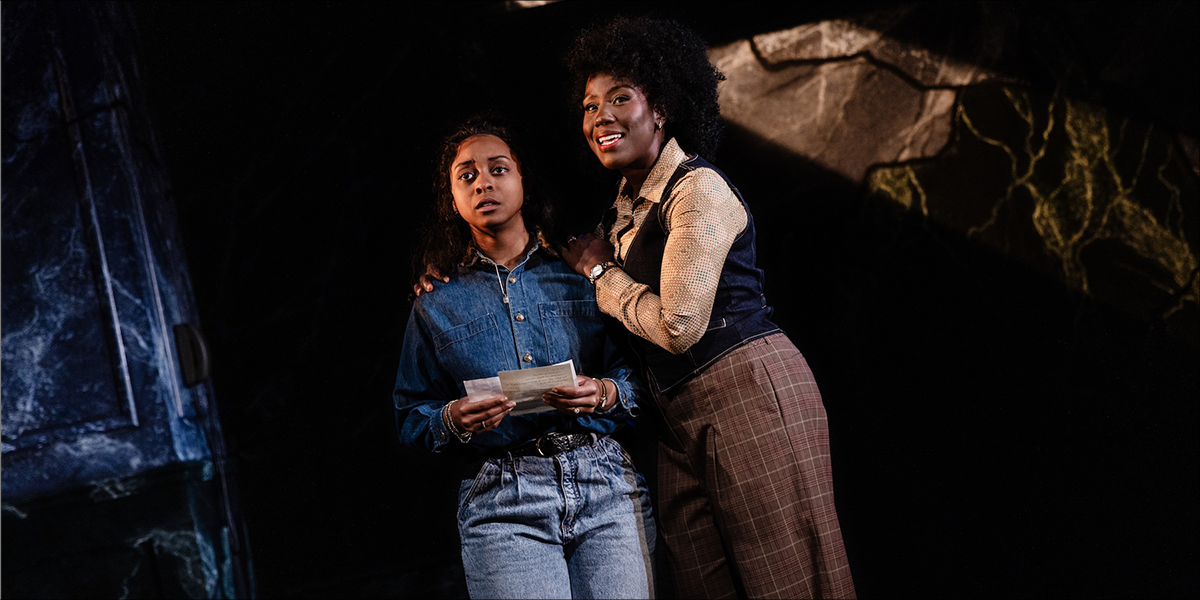
Photo credit: Alana Raquel Bowers in the ripple, the wave that carried me home off Broadway. (Photo by Marc J. Franklin)
'the ripple, the wave that carried me home' Off-Broadway review — time can't wash away all grief
Read our review of the ripple, the wave that carried me home off Broadway, a New York-premiere memory play written by Christina Anderson and directed by Tiffany Nichole Greene.
Summary
- the ripple, the wave that carried me home sees the daughter of integration activists reckon with her personal grief and resentment toward her parents
- The show features strong performances, particularly from Alana Raquel Bowers and Marinda Anderson, but an exposition-heavy story with little action
- The show is recommended for fans of family dramas like Branden Jacobs-Jenkins's Purpose, which also follows multiple generations of a politically prominent Black family
Despite its title and motif, there is little actual water in the ripple, the wave that carried me home. Christina Anderson’s play frames the figurative drowning of a child overlooked by her parents with the actual tragedy of four boys, two white and two Black, who sought an integrated place to swim and instead found a polluted, dangerous lake. An adult Janice (Alana Raquel Bowers) explains that this drowning propelled the activism of her parents, Helen (Crystal Lucas-Perry) and Edwin (Biko Eisen-Martin); it helps that Helen was already a swimmer and Edwin a proven risk-taker in the fight for integration in the fictional Beacon, Kansas.
Moving with swiftness and grace between her childhood memories and her adult life, Bowers’s Janice shows us how her parents’ dedication to the cause over the happiness, well-being, and sometimes safety of their family came to stifle and suffocate her. In 1992, living in Ohio with her unseen husband and children and avoiding her mother and her hometown, Janice may drown in a force stronger than water: grief.
If this sounds like a convoluted summary, it’s because the number of characters and memories in the ripple outweighs what they actually do on stage. Bowers is saddled with exposition, describing her grandfather, the division of Beacon’s Black communities, the details of the town’s many swim clubs, her eventual love of geology and soil, her feelings toward parenting her own sons, and her mother’s assault at the hands of a police officer. Director Tiffany Nichole Greene often has Bowers park herself and deliver this stream of information, sometimes with Eisen-Martin and Lucas-Perry moving through the background.
In flashbacks of Helen and Edwin, the dialogue becomes heavy-handed, with too many convenient leading questions: "Why would that happen?" "What do you mean by that?" Ahead of the funeral of the two drowned Black boys, Edwin mentions they cannot be buried with their white friend because Beacon’s cemeteries are segregated, to which Helen responds, “And no one asks why?” The question undermines the character’s earlier scenes that explore the history of activism in Beacon, the legacy of their parents that Helen and Edwin are carrying forward. Suddenly, the characters go from dynamic to simplistic.
At the beginning of the ripple, Janice tells us she came to hate the taste and feel of water so much that she had to force herself to chug a glass each morning. There is no literal or figurative baptism between this moment and an ending water aerobics class, when Bowers, Lucas-Perry, and a fabulous Marinda Anderson, as Janice’s Aunt Gayle, descend into an imagined pool, performing the frenetic dance of a body in too-cold water. Now, water transcends the trauma of a family, a community, and indeed a nation; the 1992 scenes address the televised trial of the Los Angeles police officers who brutally beat Rodney King. Anderson does not suggest that the play's ending would solve society's ills are solved, but rather that we can find joy in small moments and “tap into our healing energy.” The sentiment is admirable, but the ending itself feels too abrupt, with Janice’s anxiety and resentment too quickly washed aside. It's not much earlier that we learn the rupture between Janice and Edwin, whose name now adorns the swimming pool, emerged when Edwin gave her a black eye.
A common problem with plays that try to knead a pretty resolution from the dough of memory is a too-fluid concept of time: The characters have decades of it to either burden them or make them forget what they were so upset about in the first place. While Janice has years to ruminate on her childhood and her grief, to condemn Edwin or forgive him, the audience has less than two hours to meet him, understand him, and judge him. We watch scenes from Edwin’s perspective and from Janice’s, and we know he is fighting the good fight, but we also know Janice’s wounds have never healed.
Whether this lack of growth is justified may be a matter of opinion, and I didn’t feel I had enough information to form one — there are a lot of years between 17-year-old Janice’s rebellion and adult Janice’s depression, which the play skims over. Perhaps Anderson’s play would be better as a novel, especially because the story relies so much on narration and so little on action. The cast at Playwrights Horizons is tuned to each other like an orchestra, but in lesser hands, it’s easy to see how the ripple could fall flat.
the ripple, the wave that carried me home summary
Janice, a mom and college fundraising director in Ohio, is plagued by phone calls from a Young Chipper Ambitious Black Woman (as she is dubbed by other characters) from her hometown of Beacon, Kansas. The town's African American Recognition Committee wants to honor Janice’s late father, Edwin, by renaming a swimming complex after him.
Years earlier, after a group of white and Black boys drown in a lake when they could not swim together at a pool, Edwin and his wife, Helen — a talented swimmer who taught many of Beacon’s Black children — devote themselves to desegregating the city’s swimming facilities. When Edwin pressures 8-year-old Janice into speaking at a memorial event, she begins to feel that her parents are prioritizing their activism over her. As an adult, Janice grapples with the weight of Edwin’s legacy as both a leader and a father.
What to expect at the ripple, the wave that carried me home
The ripple, the wave that carried me home runs approximately 1 hour and 35 minutes without an intermission. The play discusses death, drowning, racism and racist violence, child abuse, and physical and sexual assaults, which Green stages non-graphically and delicately.
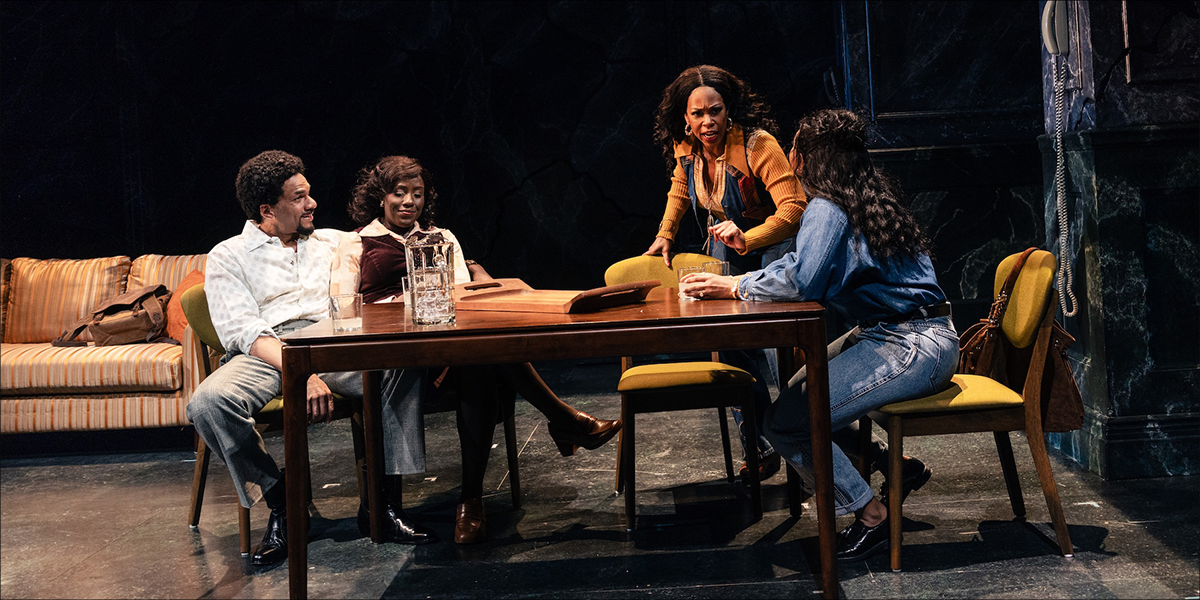
Although it deals with serious subject matter, the ripple also has a tongue-in-cheek sense of humor, with Marinda Anderson’s two characters (Gayle and Young Chipper) regularly roasting the others. There were multiple moments of boisterous laughter from my audience; a gag involving multiple landline phones is a particularly funny payoff. (They're a highlight of scenic designer Lawrence E. Moten III’s gorgeous and intricate set.)
Playwrights Horizons’s Judith O. Rubin Theater is a proscenium space with raked seating, and there is not a bad seat in the house; sightlines are easily maintained throughout the whole show.
What audiences are saying about the ripple, the wave that carried me home
Audiences have shared mixed-to-positive responses to early performances of the ripple, the wave that carried me home, which has an 81% audience approval rating on the review aggregator Show-Score as of writing.
- Mezzanine user Zachary Jordan praised the play’s comedic elements but wrote that the ending “was very wholesome in a way that made all of the strong dramatic points before feel undermined.”
- Mezzanine user Luke Hamilton said the ripple is “too much tell, not enough show.”
- Show-Score user Kim G City wrote that Anderson’s play is “beautifully written, performed, and staged” with “lots of layers and nuance.”
Read more audience reviews of the ripple, the wave that carried me home on Show-Score.
Who should see the ripple, the wave that carried me home
- Playwright Christina Anderson has had multiple lauded productions in recent years, including How to Catch Creation, which also plays with time and non-linear storytelling. Fans of her work and of time-bending stories should check out the ripple.
- If you enjoyed Cold War Choir Practice at MCC Theater last season, star Alana Raquel Bowers is once again captivating as a child with too much on her shoulders, bouncing across timelines as a younger and older Janice.
- Fans of Branden Jacobs-Jenkins’s Pulitzer and Tony Award-winning Purpose may be intrigued by another play about the children of prominent Black activists struggling to reconcile the world’s view of their family with their own experiences.
Learn more about the ripple, the wave that carried me home off Broadway
When Greene gives them license to move, the cast of the ripple dances, runs, glides so well that they almost seem to beg for more choreography. The play is desperate for a pool, for an onstage shower or spurt or puddle, for water in more than just the pitcher spotlit by lighting designer Lap Chi Chu at the top of the show. Logistical hurdles aside, it is hard to see why the production avoids water so thoroughly; it just left me thirsty.
Photo credit: the ripple, the wave that carried me home off Broadway. (Photos by Marc J. Franklin)
Frequently asked questions
What is the ripple, the wave that carried me home about?
the ripple, the wave that carried me home is a theatrical piece about the integration of swimming pools and one woman's quest to understand her family's legacy.
Is the ripple, the wave that carried me home on Broadway or Off-Broadway?
the ripple, the wave that carried me home is playing Off Broadway.
How long is the ripple, the wave that carried me home running?
the ripple, the wave that carried me home currently has tickets available through 29 November 2026. Check calendar for availability.
Who is in the cast of the ripple, the wave that carried me home?
The cast of the ripple, the wave that carried me home includes Marinda Anderson (as Gayle), Alana Raquel Bowers (as Janice), Biko Eisen-Martin (as Edwin), and Crystal Lucas-Perry (as Helen).
Who directed the ripple, the wave that carried me home?
the ripple, the wave that carried me home is directed by Tiffany Nichole Greene.
Who wrote the ripple, the wave that carried me home?
the ripple, the wave that carried me home was written by Christina Anderson.
What's the age recommendation for the ripple, the wave that carried me home?
The recommended age for the ripple, the wave that carried me home is All Ages..
Where is the ripple, the wave that carried me home playing?
the ripple, the wave that carried me home is playing at Playwrights Horizons. The theatre is located at 416 West 42nd Street (between 9th and 10th Avenue), New York, 10036.
How do you book tickets for the ripple, the wave that carried me home?
Book tickets for the ripple, the wave that carried me home on New York Theatre Guide.
How much do tickets cost for the ripple, the wave that carried me home?
Tickets for the ripple, the wave that carried me home start at $44.
What awards has the ripple, the wave that carried me home won?
This play won the Horton Foote Prize for Playwriting because of its "poignant, subversive" writing.
Originally published on
Latest News
- 1
Here are the Broadway shows you can see over the holidays
- 2
Jordan Fisher to star in ‘Purple Rain’ Broadway musical
- 3
‘Paddington’ musical sets Broadway cast
- 4
The real history behind ‘Here There Are Blueberries’ on Broadway
- 5
Complete cast set for 'Awake and Sing!' on Broadway
- 6
‘Buena Vista Social Club’ to close on Broadway
- 7
15 things to do in NYC this month
- 8
Broadway and Off-Broadway rush and lottery theatre ticket guide: Shows that offer rush and lottery tickets
- 9
'Maybe Happy Ending' tickets now on sale through April 2027
- 10
Derek Klena to join 'The Great Gatsby' Broadway cast
Related articles
Subscribe to our newsletter to unlock exclusive New York theatre updates!
- Get early access to Broadway's newest shows
- Access to exclusive deals and promotions
- Stay in the know about top shows and news on Broadway
- Get updates on shows that are important to you
You can unsubscribe at any time. Privacy Policy