


Wendy Wasserstein's 'An American Daughter' returns, putting women back at the forefront
Producer and star Jean Lichty, co-star Montego Glover, and director Sarna Lapine discuss rediscovering the 1997 political drama about an accomplished women's public takedown.
Summary
- Producer and star Jean Lichty; co-star Montego Glover; and director Sarna Lapine discuss reviving Wendy Wasserstein's An American Daughter
- The 1997 political drama follows a woman's public takedown in the media over a minor misstep
- The show examines themes of public scrutiny and gender-based double standards
“Why are we so afraid of intelligent and powerful women?” asked Sarna Lapine, director of the upcoming revival of An American Daughter presented by La Femme Theatre Productions. It is exactly this question that drives the show, playing at the Pershing Square Signature Center from July 23 to September 6. La Femme artistic director Jean Lichty produces and stars in the timely mounting of Wendy Wasserstein’s sharply observed 1997 political drama, which arrives at a moment when its central themes feel remarkably relevant.
This production continues the legacy of Wasserstein, the trailblazing first woman to win both the Pulitzer Prize for Drama and the Tony Award for Best Play as a solo playwright for The Heidi Chronicles. Just last month, playwright Bess Wohl brought Wasserstein back into the cultural spotlight by dedicating her own Tony Award win for Liberation to the late writer, becoming the first American female playwright since Wasserstein to capture both the Tony Award for Best Play and the Pulitzer Prize for Drama on her own.
When asked how the new staging of An American Daughter converses with contemporary playwrights who are actively honoring Wasserstein, Tony Award nominee Montego Glover, who co-stars in the production with Lichty, noted that the revival makes its statement simply by being staged.
“Making something that has Wendy’s hand on it, like her voice inside it, is somehow energetically correct and prophetic and aligned,” Glover said.

A public unraveling and a private bond
An American Daughter centers on Dr. Lyssa Dent Hughes (Lichty), a brilliant and accomplished woman from a prominent American political family who finds herself nominated for a high-profile position. However, her seamless ascent to the national stage is abruptly threatened when a seemingly minor, mundane personal oversight is brought to light, igniting a relentless media takedown. The play charts how public scrutiny, sexual politics, and the impossible standards placed on female leaders can unravel a woman’s career.
Standing beside Lyssa in the storm is her fiercely loyal friend Judith B. Kaufman (Glover), who carries her own deep heartbreaks while serving as Lyssa’s emotional anchor. The late Lynne Thigpen won a Tony Award for her turn as Judith in the original Broadway production. Glover found herself struck by the play’s eerie foresight into how modern society treats ambitious women, noting she was “rattled” by its “uncanny sharpness” upon reading it.
Glover expressed that the play’s themes, ranging from the relentless cycle of media scrutiny to the aggression often directed at women, felt starkly familiar when she first read the script. To better understand Judith’s layered personality, Glover turned to biographies of Wasserstein to immerse herself in the playwright’s own life and sensibilities as well.
2026 urgency through a 1997 lens
For Lichty, who balances producing the revival with the demands of playing Lyssa, the decision to mount the play was deeply tied to the current political landscape.
“I was so devastated by the [presidential] defeat of Kamala Harris that I met with my board in early 2025 to discuss an appropriate play to address the demise of powerful, smart women in America’s political arena,” Lichty said, adding that she felt an overwhelming responsibility to bring Wasserstein’s sociopolitical insight back to the stage.
Despite the striking modern parallels, Lapine intentionally chose to keep the production in its original 1997 setting. The director emphasized that placing the story before the social media era helps illuminate how the destruction of a woman’s reputation at that time carried the severe weight of factual reporting rather than modern internet sensationalism. This distinction is critical when establishing the analog world of Lyssa’s highly educated, politically entrenched family.
“There will be no screens in this production,” Lapine said. “This was a time when media was still relatively analog. This was a household that had subscriptions to every single highbrow journal publication that they would have had access to, and they were reading five papers at the table drinking coffee every morning.”
Lapine pointed out that the double standard for women in leadership is so normalized that the 1990s backdrop offers a crucial vantage point for reflection. “I don’t think the play fully got its due at that time,” Lapine said. “I want to honor how precious Wendy was from the vantage point from which she was writing it, and that a period piece sometimes has greater capacity to shed light on the times we’re living in today.”

A reimagined finale
This La Femme revival also offers audiences an extraordinary update: the integration of an unpublished second act Wasserstein developed during a later Chicago run. This version shifts the narrative focus of the play’s climax entirely. In the original Broadway production, the final moments heavily featured the men in Lyssa’s life reacting to the fallout of her political demise. The Chicago draft, however, “ends with Judith,” Lichty said. “It ends with the women instead of the husband and the father.”
For Lichty, stripping away the male figures to focus solely on the enduring, complicated friendship between Lyssa and her closest confidante cements the emotional center of the play. “Every time I read that scene, I cry because these women love one another and have been supporting one another for decades,” Lichty said.

Balancing comedy, tragedy, and conversation
Navigating the devastating public ruin of an accomplished woman requires a delicate tonal balance, a hallmark of Wasserstein’s legendary voice.
“She was really smart and really funny, and she understood how to use humor as a tool to disarm people in order to let these important ideas kind of seep into our consciousness,” Lapine said of the playwright.
As An American Daughter invites reflection on how the American dream can be fractured by societal expectations, the cast and creative team aspire for the production to spark a vital, ongoing dialogue.
“I hope that when the lights come down, conversation starts immediately,” Glover said. “People start talking, start sharing with other people what they saw, what they heard.” She added, “I hope that people can see themselves in these characters and see themselves in ways they did not know existed.”
Get An American Daughter tickets now.
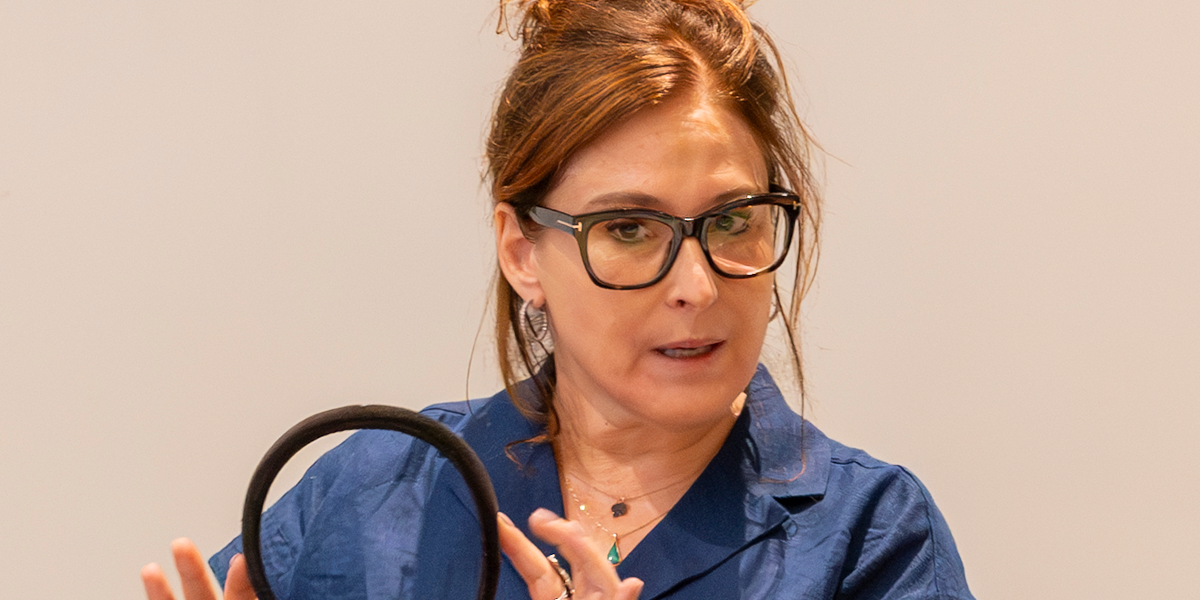
Photo credit: An American Daughter in rehearsal. (Photos by Russ Rowland)
Originally published on
Latest News
- 1
Original stars Nikki M. James, Rory O’Malley to return to ‘The Book of Mormon’ on Broadway
- 2
Bernie Williams to join 'Buena Vista Social Club' on Broadway; José "Candelita" Iglesias extends run
- 3
A timeline of the record-setting musical ‘The Fantasticks’
- 4
Six Degrees of Broadway Stages: Connecting all the Broadway shows in the New York Theatre Sale
- 5
Shop the New York Theatre Sale for Broadway ticket deals and more
- 6
10 Broadway artists who are double-booked this season
- 7
Rosie O'Donnell to play two-week run in 'The Rocky Horror Show' during Rachel Dratch's leave
- 8
‘Two Strangers (Carry a Cake Across New York)’ to close on Broadway in November
- 9
New York Theatre Sale returns with limited-time deals on Broadway tickets
- 10
'The Outsiders' tickets now available through July 2027
Related articles
Subscribe to our newsletter to unlock exclusive New York theatre updates!
- Get early access to Broadway's newest shows
- Access to exclusive deals and promotions
- Stay in the know about top shows and news on Broadway
- Get updates on shows that are important to you
You can unsubscribe at any time. Privacy Policy