


'Public Charge' Off-Broadway review — how far can faith in government go?
Read our review of Public Charge on Broadway, a new drama written by former U.S. Ambassador Julissa Reynoso and Michael J. Chepiga, and inspired by true events.
Summary
- Public Charge dramatizes the real-life experiences of diplomat Julissa Reynoso as a U.S. Ambassador to Cuba and other Caribbean and Central American countries
- Reynoso co-wrote the show with Michael J. Chepiga
- The show plays out straightforwardly and struggles to land emotional and dramatic beats in its story of international intrigue
- The show is recommended for political science buffs and students; as well as those following current events including the current U.S. oil embargo on Cuba
Say what you will of the current Chess revival on Broadway, it lands its point that international diplomacy can feel like a melodramatic game. In contrast, Public Charge, an autobiographical political drama at The Public Theater, only flirts with Chess's flair in its mostly dry, straightforward proceedings.
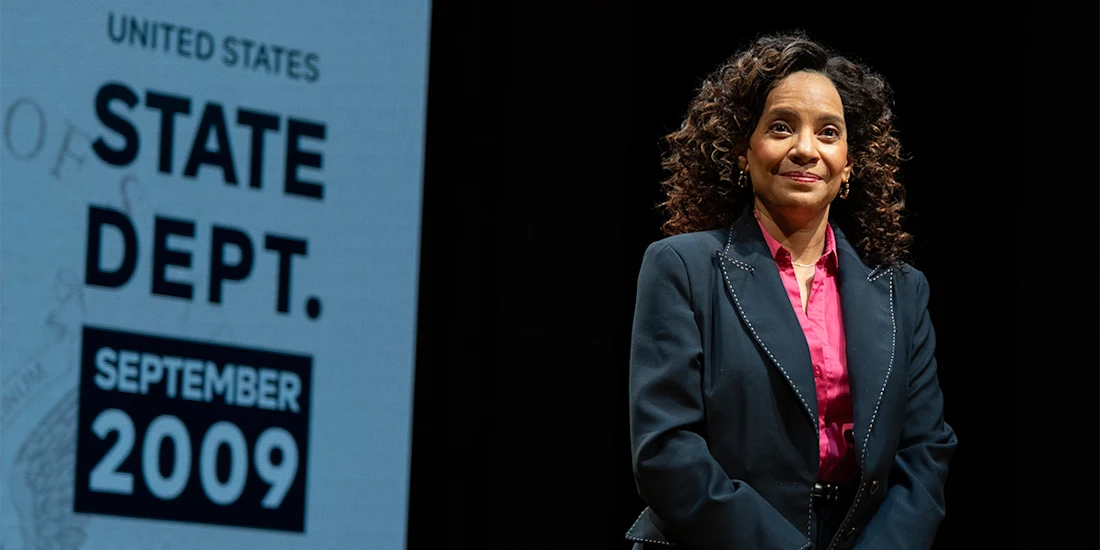
The show's main character is former U.S. Ambassador Julissa Reynoso, who also co-wrote it with former law firm co-worker and playwright Michael J. Chepiga. Director Doug Hughes struggles to string together the play’s Obama-era intrigue: Reynoso (Zabryna Guevara) has a mission to free Alan Gross, an accused U.S. spy, from Cuban imprisonment. In a succession of trial-and-error conversations, the diplomatic red tape steers Reynoso into adjacent international affairs, such as the 2010 earthquake relief in Haiti, a quid pro quo transaction coded as a humanitarian gesture. A fertility matter between a Cuban spy and his wife becomes relevant. Diplomacy requires improvisation within negotiations.
This material is rich, covering Reynoso’s lived immigrant experience, her nebulous position on the ideological binary, and the uncontrollable variables happening beyond her position as a public servant. One gets the inkling that the real Reynoso is channeling criticism against the U.S. government, as her stage avatar frets about getting little information about Gross and later invoking the U.S.'s history of anti-communist interference and intervention in Latin America that complicates her job. Unfortunately, these ideas play out more intricately on paper, when the script is not slipping into platitudes about “good-intentioned government people,” than in Hughes’ cold direction.
Although Guevara plays Reynoso competently, with snark and frothing frustration, she can only tease out further nuances within her suppressed outrage and professional maneuvers. Other actors step up to the task of injecting color into the material. Maggie Bofill, as Cuban diplomat Josefina Vidal, does not conceal her acid smugness. As Alan Gross's wife, Judy, Deidre Madigan (who assumed the role from Barbara Walsh) is stellar as a bereaved woman who grills Reynoso on whether she’s another government pawn with empty promises, even if Judy’s presence becomes curiously meager by the end.
Toward the end, the play lands with two tonal thuds. The first depicts one of Reynoso's nightmares, where admonishing bodies encircle her like vultures, as though the production suddenly longs to be a musical (are we back in Chess?). The second awkwardly mentions the presidential campaign of Hillary Clinton (with whom Public Charge is produced by special arrangement) and gestures toward the Trump administration, the second term of which is currently imposing an oil embargo on Cuba.
My audience laughed nervously as Reynoso vowed to get Clinton elected, as if the play is ushering in a Shakespearean tragic hero. This final scene seems like the play’s cross-examination of itself, acknowledging that faith in the government might as well be taking not just a fall, but a farcical plunge. But its abruptness sidesteps a real sense of reflection.

Public Charge summary
Moving from 2009 to 2014 with few flashbacks, Public Charge follows public servant Julissa Reynoso, assigned to supervise Caribbean and Central American affairs for Secretary of State Hillary Clinton under the Obama administration. She’s bewildered by her task to free an accused American spy, Alan Gross, from the Cuban government’s imprisonment. In spite of her belief the job should have gone to Ricardo Zuniga (Dan Domingues), a more experienced foreign service officer, Reynoso is prompted to think outside the box to budge the Cuban government to free Gross. She learns the hard way that policy is often unshakable, and her background as a Dominican immigrant can make her a target.
The play’s title is the legal term for someone likely to become dependent on the government for survival. As the play demonstrates, the phrase often a carries a xenophobic stigma.
What to expect at Public Charge
Running for an intermission-free 100 minutes, Public Charge places audiences on opposite sides, and the stage is equipped with video screens (video design is by Lucy Mackinnon) that display the year, location, and photos. In addition, it bears the opening disclaimer: “The opinions and characterizations in this piece are those of the authors and do not necessarily represent those of the U.S. government.”
Arnulfo Maldonado’s minimal set design consists of abstract, vaguely chess-inspired platforms with steps, where Reynoso converses with other players. Along with solid sound design by David Van Tieghem, set transitions are punctuated with percussion-sharp original music by Carlos Henriquez and Tieghem, which underlines the lived experience that motivates Reynoso’s career.

What audiences are saying about Public Charge
Theatregoers at early performances have primarily discussed Public Charge on the theatre tracking and review app Mezzanine.
- Mezzanine user Sarah Tritz called the show a “pretty unflattering, not-super-functional autobioplay.”
- Mezzanine user kat c said, “I often wonder if [the] play is just laying out a series of historical events through characters mostly standing/sitting there talking…”
- “I’ve been struggling with how I feel about the play’s portrayal of Julissa and how she’s portraying herself. It felt like a political version of 'I’m not like the other girls.' The current political climate made it hard to laugh alongside the audience at the ending scene, which ultimately did not hit for me.” - My +1 at the show
Who should see Public Charge
- Those monitoring the current embargo on Cuba may be interested in how Public Charge dramatizes a past moment in the history of Cuba-U.S. relations, as well as the violence of U.S. intervention and interference in Latin American politics.
- Public Charge explores representational politics. Reynoso’s immigrant background and personal closeness to the Latino community gives her career-relevant insight, such as the complex ideological politics demonstrated by Reynoso’s anti-Reagan father debating with a pro-Reagan Cuban American bodega owner.
- Like political plays including 2024's N/A, Public Charge may interest political science students and teachers.
Learn more about Public Charge off Broadway
The interconnected themes of Public Charge begin to feel more like an accumulation than a complex tableau of a diplomat, her personal struggles, and international politics, with its tone going astray toward the end. The production flattens what it means to be a chess piece of the American government.
Photo credit: Public Charge off Broadway. (Photos by Joan Marcus)
Originally published on
Latest News
- 1
'Now You See Me Live' to play limited holiday run on Broadway
- 2
One-night-only 'Bill Pay' Broadway musical to star Billy Porter, Billy Zane, Jessica Vosk
- 3
‘& Juliet’ sets Broadway closing date
- 4
Horror stories are bone-chillingly big on and off Broadway this season
- 5
Gina Torres to star in 'Buena Vista Social Club' on Broadway
- 6
Guide to 'Small Mouth Sounds' on Broadway starring Julia Roberts, Paul Rudd, Sarah Paulson, Martin Freeman, Greta Lee, and Isaac Powell
- 7
Sherri Shepherd to join 'Aladdin' on Broadway
- 8
Julia Roberts, Paul Rudd, Sarah Paulson, Martin Freeman, Greta Lee, Isaac Powell to star in ‘Small Mouth Sounds’ on Broadway
- 9
'Inter Alia' sets Broadway cast joining Rosamund Pike
- 10
Acclaimed play ‘Downstate’ to transfer to Broadway
Related articles
Subscribe to our newsletter to unlock exclusive New York theatre updates!
- Get early access to Broadway's newest shows
- Access to exclusive deals and promotions
- Stay in the know about top shows and news on Broadway
- Get updates on shows that are important to you
You can unsubscribe at any time. Privacy Policy