


'The Adding Machine' Off-Broadway review — timely drama shows a lifetime of work that adds up to nothing
Read our review of The Adding Machine off Broadway, Thomas Bradshaw's new revision of Elmer L. Rice's 1923 expressionist play, presented by The New Group.
Summary
- The Adding Machine follows a menial worker's journey through life and the afterlife after he's fired and replaced with a machine
- The 100-year old show has relevant themes of corporate greed and the effects of technological advancements on humans but the production is dated and slow-moving in other ways
- The show is recommended for fans of Daphne Rubin-Vega; Jennifer Tilly; Sarita Choudhury; and Michael Cyril Creighton who want to see these actors on stage
Does artificial intelligence being integrated into nearly every workplace and taking human jobs fill you with murderous rage? If so, The Adding Machine might be for you.
Unexpected as it may seem, Elmer L. Rice’s 1923 play is eerily prescient, predicting the AI hellscape we’re currently living in. After 25 years of dedicated, if mindlessly boring, work adding figures, the aptly named Mr. Zero (Rent's Daphne Rubin-Vega) is fired and replaced with a new piece of technology: an adding machine. This device, which can be run by any non-skilled worker, has made both Mr. Zero and his assistant, Daisy (And Just Like That's Sarita Choudhury), redundant. The news, compounded with an unfulfilling marriage to his wife (Bullets Over Broadway's Jennifer Tilly), causes Mr. Zero to snap in a way that is extreme, although almost understandable.
The theme of corporate greed obsessing over cheap, efficient robot labor, and the toll it takes on human employees, is well-explored and strikingly modern, despite the play being over a hundred years old. But in many other ways, the play shows its age. It’s expressionist, so it features characters who represent archetypes instead of individuals, stilted and stylized dialogue, philosophical ramblings, and endless monologues. All this can get quite grating over time. Thomas Bradshaw has revised Rice's script, but he has left too much intact to appeal to a current audience, including violently offensive language that doesn’t particularly serve the plot.
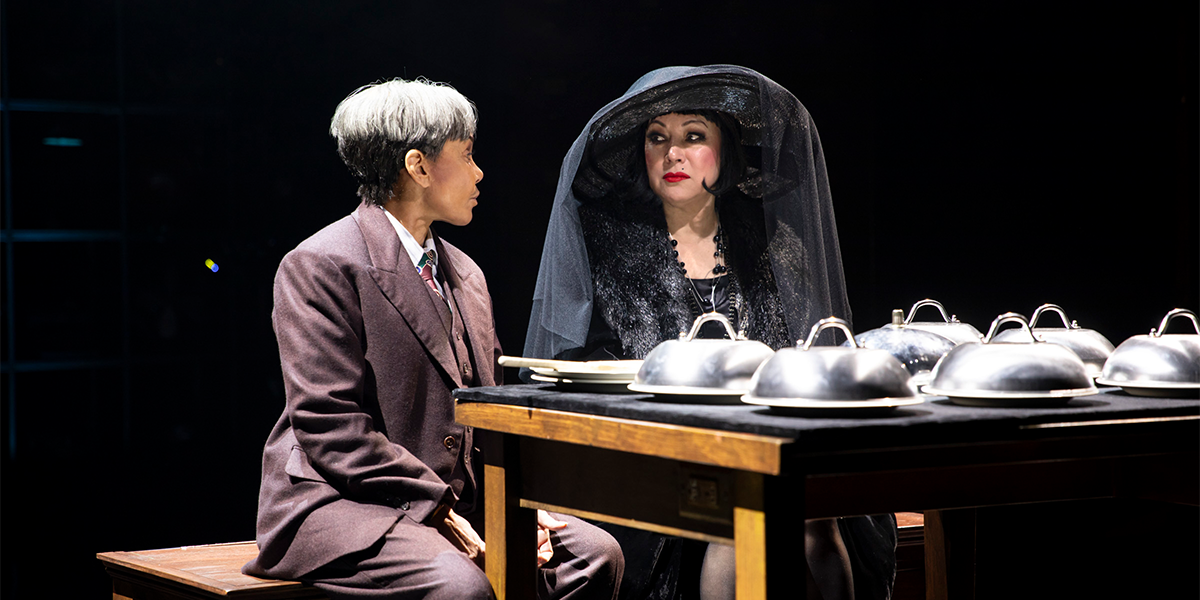
Scott Elliott’s direction embraces The Adding Machine's weirdness, often to a fault. Rubin-Vega and Tilly both perform like cartoon characters, with exaggerated, misbegotten accents and melodramatic gestures. As the 2-hour, 15-minute play wears on — especially in a less plot-driven, more experimental second half that drags — Rubin-Vega’s schtick annoyingly detracts from the more serious messages the play is trying to get across. Those messages, though, become muddled by the end as the play gets into reincarnation: Are humans trapped in our roles, either getting exclusively better or worse with each new life? Tasked with explaining much of this is Michael Cyril Creighton, who plays a host of roles, including a narrator and, in a shining moment, 12 party guests at once.
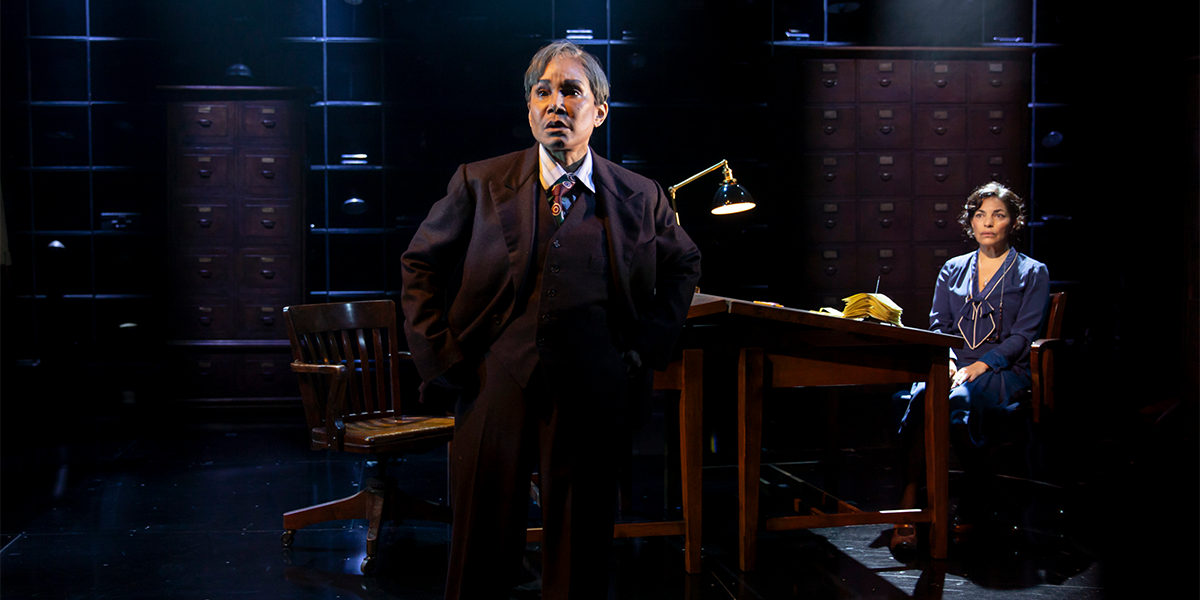
Choudhury is our saving grace, and her office scene with Rubin-Vega is beautifully executed, in part due to clever direction and dynamic lighting by Jeff Croiter, the real star of the show. It is rare to leave a play thinking about the lighting, but Croiter’s top-notch work helps breathe life into an otherwise lumbering production. Thank god he hasn’t been replaced by a machine yet.
The Adding Machine summary
Elmer L. Rice’s The Adding Machine tackles what happens when a new piece of technology renders workers obsolete, exacerbating the already difficult, joyless monotony of “modern life.” Mr. Zero is deeply unsatisfied in his marriage and unappreciated at his job, where he has been adding figures for 25 years without ever missing a day. When his boss replaces him with a machine, he has a breakdown that finally sets his life on a different (though not better) course. From there, the play explores more philosophical questions about life, death, love, labor, and purpose.
What to expect at The Adding Machine
The Adding Machine is the first production in The New Group’s new home, the Theatre at St. Clements, a church in Hell’s Kitchen. On stage beneath the church's vaulted ceilings, there is a large old-fashioned adding machine, operating autonomously: mechanically typing its keys, rhythmically pulling down a level, and spitting out a never-ending string of a receipt paper that spools into a pile. Wooden filing cabinets are cleverly used as a modular set in Derek McLane’s scenic design, and a grid-like shelving unit holds various period-appropriate lamps, fans, and typewriters to set the mood and loom over the space.
The show runs 2 hours and 15 minutes, including one intermission. The play contains a large amount of offensive language, racial slurs, and extended discussions of suicide intact from the original 1923 script.
What audiences are saying about The Adding Machine
Although some theatregoers found the themes very relevant, many criticized The Adding Machine's length and offensive language, despite excitement for the starry cast, on various online platforms.
- “The Adding Machine is a timeless critique on the cutthroat corporate culture of capitalism due to tech advancement and automation, and how it leaves the dedicated working class unemployed and uncertain, questioning their purpose and spirituality. Some things never change.” - X user Jennifer D. Laws
- “The show drags toward the end (especially second act) and could benefit from some trimming. The repeated use of slurs also felt so unnecessary to me, other language choices could have landed the same punch. That said, it did spark an interesting thought: we're sprinting forward technologically while somehow regressing in our society.” - Reddit user Key-Flan-6996
- “The characters were all so deeply unlikable I couldn’t have cared less what happened after intermission. I had such high hopes based on the cast too! Deeply disappointed.” - Reddit user JulieKocsis
- “I really wanted to like this show but I found myself so incredibly bored…The subtext and themes of the work are fascinating and deep. But the actual dialogue moves the story at a snail pace and just wasn’t good. The show was trying too hard to be artistic or unique. There were too many drawn out monologues. There were also many unnecessary racial slurs that just didn’t add to the story….Granted there were some really well done scenes, but overall they were too few and far between to save the show.” - Mezzanine user Nick Cairano
Who should see The Adding Machine
- Anyone fed up with the amount of AI being thrust upon us, especially in workplace environments, will find an outlet for their frustrations here.
- Fans of the cast’s work on film and television may enjoy getting to see them on stage.
- Audience members interested in revivals of old works that speak to our moment will enjoy this production, especially if they like the 1920s and expressionism.
- Appreciators of well-crafted sets and lighting will appreciate the thoughtful design.
Learn more about The Adding Machine off Broadway
The Adding Machine offers a needed anti-AI screed for our times, but the machinery is deeply flawed and weighed down by faulty performances, uneven direction, and a dated script.
Photo credit: The Adding Machine off Broadway. (Photos by Monique Carboni)
Originally published on
Latest News
- 1
Original stars Nikki M. James, Rory O’Malley to return to ‘The Book of Mormon’ on Broadway
- 2
Bernie Williams to join 'Buena Vista Social Club' on Broadway; José "Candelita" Iglesias extends run
- 3
A timeline of the record-setting musical ‘The Fantasticks’
- 4
Six Degrees of Broadway Stages: Connecting all the Broadway shows in the New York Theatre Sale
- 5
Shop the New York Theatre Sale for Broadway ticket deals and more
- 6
10 Broadway artists who are double-booked this season
- 7
Rosie O'Donnell to play two-week run in 'The Rocky Horror Show' during Rachel Dratch's leave
- 8
‘Two Strangers (Carry a Cake Across New York)’ to close on Broadway in November
- 9
New York Theatre Sale returns with limited-time deals on Broadway tickets
- 10
'The Outsiders' tickets now available through July 2027
Related articles
Subscribe to our newsletter to unlock exclusive New York theatre updates!
- Get early access to Broadway's newest shows
- Access to exclusive deals and promotions
- Stay in the know about top shows and news on Broadway
- Get updates on shows that are important to you
You can unsubscribe at any time. Privacy Policy